

Every firm relies on professional talent to drive business success. Consequently, the recruitment process plays a pivotal role in an organization’s lifecycle. Identifying appropriate personnel ensures long-term growth, innovation, and stability.
In today’s competitive landscape, firms must utilize multiple strategies to recruit the crème de la crème. While digital tools have revolutionized hiring, a mix of traditional and modern tactics is often best. Below, we explore eight excellent recruitment tactics that businesses can use to establish a robust team.
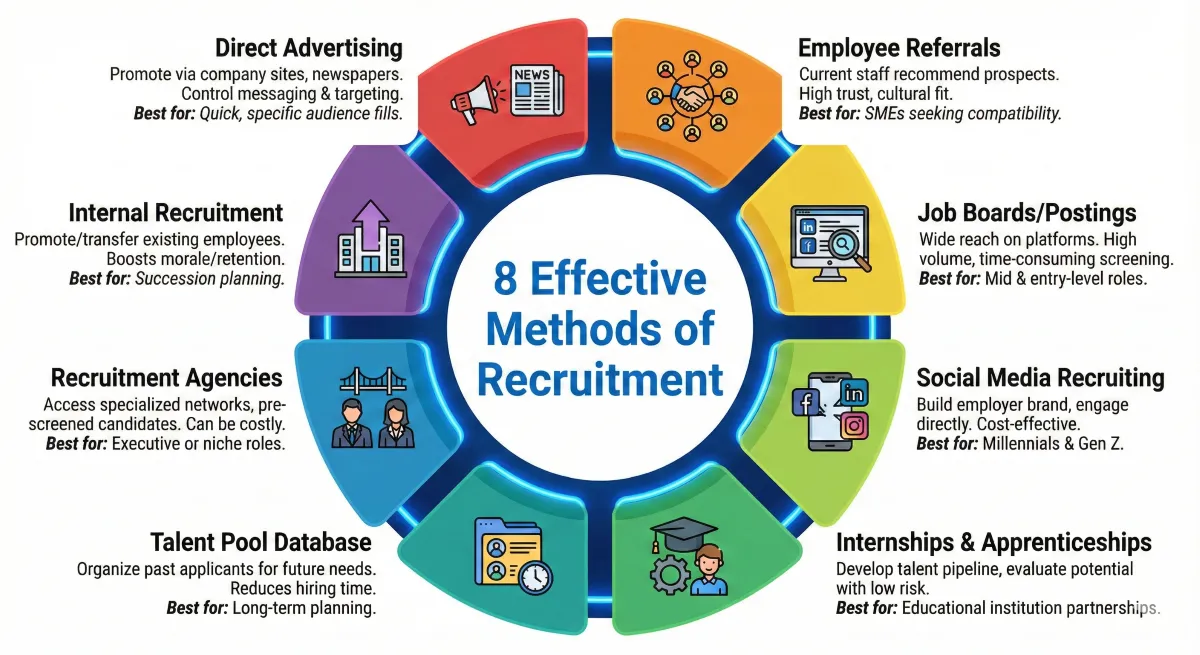
8 Effective Methods of Recruitment
Recruitment isn’t a one-size-fits-all solution. Companies must utilize a variety of strategies to discover qualified people based on their specific requirements, industry, and available resources.
Here are eight effective recruitment tactics for modern firms:
1. Direct Advertising
Direct advertising entails promoting job openings through venues such as newspapers, company websites, and industry publications. This strategy gives businesses complete control over their messaging, allowing them to target specific candidate groups through tailored advertisements.
-
Pros: Cost-effective and provides total control over job descriptions and branding.
-
Cons: It may not reach “passive candidates” who are not actively looking for work.
-
Best for: Organizations that need to fill vacancies quickly with a specific audience in mind.
2. Employee Referrals
One of the most reliable recruitment approaches is to encourage current employees to refer new applicants. Employees generally recommend friends or past coworkers who they know are capable and culturally aligned.
-
Pros: Increases trust in the recruitment process, ensures better cultural fit, and reduces hiring time.
-
Cons: Over-reliance on this method may result in a lack of diversity or “echo chambers.”
-
Best for: Small to medium-sized organizations seeking culturally compatible people.
3. Job Boards and Postings
Companies can access a massive pool of candidates on sites such as LinkedIn, Indeed, and Glassdoor. Detailed job descriptions help firms attract active job searchers, while niche job boards can target specific industries. HR recruitment agencies can also assist in managing these postings to find high-potential individuals.
-
Pros: Wide reach and high visibility.
-
Cons: High volumes of applications can make the screening procedure time-consuming.
-
Best for: Companies seeking to fill mid-level and entry-level positions.
4. Social Media Recruiting
With the dominance of LinkedIn, Facebook, and Instagram, social media recruiting is essential for modern employment. Organizations can promote openings, highlight their business culture, and communicate directly with possible candidates.
-
Pros: Cost-effective and excellent for employer branding.
-
Cons: Requires regular content maintenance and active engagement.
-
Best for: Reaching millennial and Gen Z prospects who are digital natives.
5. Internships and Apprenticeships
A wonderful approach to developing potential employees is through internships or apprenticeship programs. This acts as a “try before you buy” method, allowing firms to analyze talents and cultural fit with low risk. Permanent staffing services can often help pool individuals for these roles.
-
Pros: Low-risk evaluation and excellent for training.
-
Cons: Generally limited to entry-level positions and requires an investment in training time.
-
Best for: Businesses trying to develop a long-term talent pipeline through educational institutions.
6. Talent Pool Databases
Maintaining a talent pool database entails gathering and organizing profiles of people who may be qualified for future positions. This could include previous silver-medalist applicants or people met at networking events.
-
Pros: Significantly reduces the time-to-hire and lowers advertising expenditures.
-
Cons: Data must be kept up-to-date to be useful.
-
Best for: Organizations that prioritize proactive, long-term talent planning.
7. Recruitment Agencies
Recruitment services specialize in finding candidates for specific sectors or professions. These agencies have access to a large network of prospects and can speed up the hiring process by providing pre-screened individuals.
-
Pros: Saves internal HR time and provides access to hard-to-find talent.
-
Cons: Can be costly due to placement fees.
-
Best for: Executive roles or when specific in-house technical knowledge is unavailable.
8. Internal Recruitment (Promotions & Transfers)
Note: I added this section to complete your list of 8.
Before looking externally, companies should look within their own ranks. Internal recruitment involves promoting existing employees or transferring them to new roles where their skills are needed.
-
Pros: Boosts morale/retention, costs very little, and the candidate already knows the company culture.
-
Cons: Creates a vacancy elsewhere in the organization that still needs to be filled.
-
Best for: Roles requiring deep institutional knowledge or for succession planning.
Conclusion
Recruiting the right people is both an art and a science. With the right HR recruitment methods, a firm can secure professionals who understand the business and drive excellence. Each approach has its own set of benefits and should be tailored to specific requirements.
Ultimately, knowing the organization’s goals, culture, and resources is necessary for adopting the most effective recruitment strategy. By integrating these tactics, companies can build a strong, future-proof workforce.