

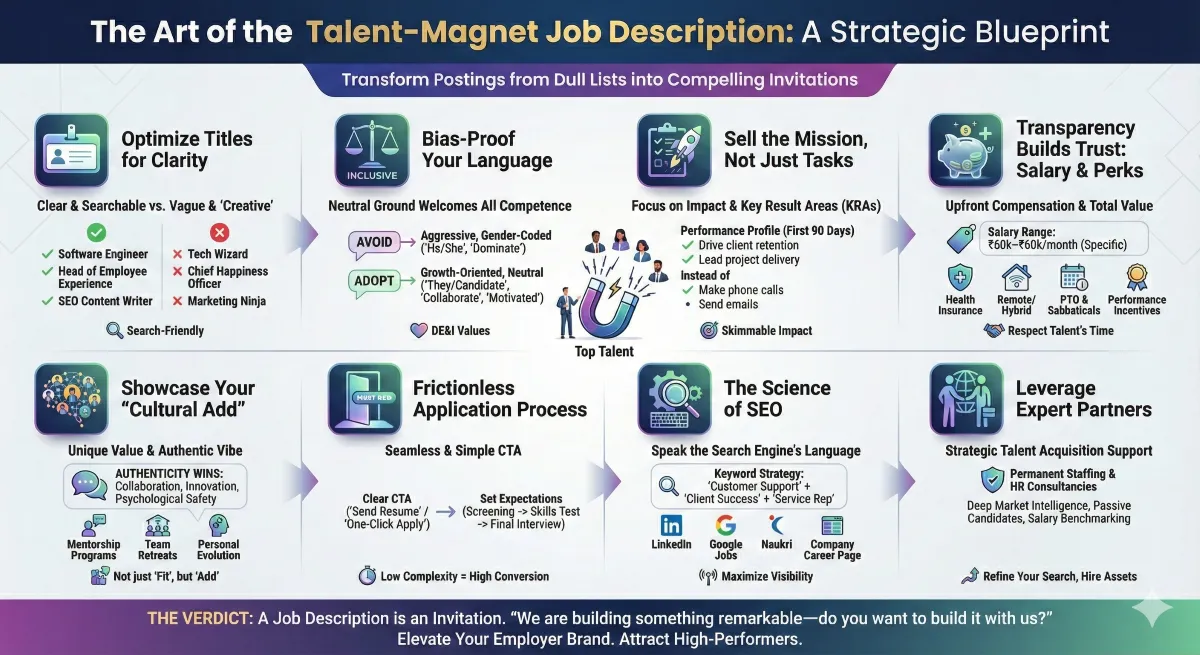
First impressions aren’t just important—they are decisive. In the current talent landscape, your job description (JD) is your company’s first handshake. If that handshake is limp, vague, or confusing, you aren’t just losing applicants; you are filtering out the high-performers who value clarity and purpose.
Top-tier talent won’t invest time deciphering a mediocre job posting. To attract the best, your JD must do three things: engage, inform, and compel. Here is the strategic blueprint for crafting job descriptions that don’t just get read, but get results.
1. Optimize Titles for Clarity and Searchability
Your job title is the headline of your advertisement. If it fails to communicate the role instantly, you lose the candidate. Avoid the temptation to use “creative” internal titles that hold no meaning in the external market.
- The Trap: Using terms like Marketing Ninja or Tech Wizard. These confuse candidates and confuse search engine algorithms.
- The Fix: Use industry-standard nomenclature.
 Bad: Chief Happiness Officer
 Good: Head of Employee Experience
- Bad: Digital Overlord
- Good: Senior Digital Strategist
Expert Insight: If a role requires a specific niche, use a qualifier. “SEO Content Writer” performs significantly better than a generic “Content Writer” because it signals expertise immediately.
2. Bias-Proof Your Language (Inclusivity is Non-Negotiable)
Language shapes perception. Research confirms that gender-coded or biased language can alienate up to 50% of your talent pool. To build a diverse workforce, your JD must be a neutral ground that welcomes competence above all else.
- Avoid: Aggressive, “bro-culture” terms like “dominate,” “crush it,” or “young and energetic.”
- Adopt: Growth-oriented language like “collaborate,” “drive results,” and “motivated.”
- The Tweak: Replace “he/she” with “they” or “the candidate.”
If Diversity, Equity, and Inclusion (DE&I) are pillars of your organization, explicitly state them. Make candidates feel that they will be valued for who they are, not just what they do.
3. Sell the Mission, Not Just the Task List
A common mistake is turning the JD into a laundry list of daily chores. High-performers want to know the impact they will have, not just the buttons they will push.
- Structure: Focus on the top 5–7 Key Result Areas (KRAs).
- Clarity: Use bullet points to make the section skimmable.
- Instead of: “Responsible for making phone calls to clients.”
- Try: “Manage client relationships via phone and email to ensure high satisfaction and retention.”
Expert Insight: Give the candidate a “Performance Profile”—a glimpse of what success looks like in their first 90 days.
4. Transparency Builds Trust: Salary & Perks
In the modern market, salary transparency is a competitive advantage. Candidates view the absence of a salary range as a red flag. If you respect their talent, respect their time by being upfront about the compensation.
- Be Specific: “Salary range: ₹50,000–₹60,000/month (commensurate with experience)” is far superior to “Competitive Salary.”
- The Total Package: Your Employee Value Proposition (EVP) is more than money. Highlight the perks that drive retention:
- Comprehensive Health Insurance
- Remote/Hybrid Flexibility
- Paid Time Off (PTO) & Sabbaticals
- Performance Incentives
5. Showcase Your “Cultural Add”
Candidates aren’t just looking for a paycheck; they are looking for a tribe. Cultural fit is outdated; look for “cultural add”—what unique value can they bring to your environment? Use this section to paint a picture of life at your company.
- Authenticity Wins: Skip the corporate jargon.
- “We value collaboration, innovation, and psychological safety. From monthly team retreats to mentorship programs, we invest in your personal and professional evolution.”
6. Frictionless Application Process
You have hooked them with the content; don’t lose them on the logistics. The application process should be seamless. Complexity is the enemy of conversion.
- Clear Call to Action (CTA): “Send your resume and a brief cover letter to careers@company.com” or “Click ‘Apply Now’ for a 2-minute application process.”
- Set Expectations: Briefly outline the hiring roadmap (e.g., “Screening call > Skills Assessment > Final Interview”) so they know what to expect.
7. The Science of SEO (Search Engine Optimization)
A great JD is useless if nobody sees it. To rank on Google Jobs, LinkedIn, and Naukri, you must speak the language of the search engine.
- Keyword Strategy: If you are hiring a ‘Customer Support Associate,’ ensure you weave in synonymous keywords like ‘Customer Service Representative’ or ‘Client Success Executive’ naturally within the text.
- Distribution: Don’t rely on one channel. Post on LinkedIn, specialized industry boards, and your own career page to maximize visibility.
8. Leverage Expert Partners
Talent acquisition is a specialized function. Sometimes, the most strategic move is to bring in the heavy hitters.
If you are facing a talent crunch or high-volume requirements, partnering with Permanent Staffing experts or HR Consultancies is a smart investment. Firms like Fifth Element HR—one of India’s premier HR consultancies—bring deep market intelligence, access to passive candidates, and salary benchmarking data that internal teams often lack. They refine your search to ensure you aren’t just filling a seat, but hiring a future asset.
The Verdict
A job description is not a demand; it is an invitation. It is your way of asking, “We are building something remarkable—do you want to build it with us?” When you prioritize clarity, inclusivity, and honesty, you do more than fill a vacancy. You elevate your employer brand and attract the kind of talent that drives businesses forward.