Human Resources is no longer just about hiring and firing; it is the heartbeat of organizational health. As the backbone of workforce management, HR professionals bridge the gap between business goals and employee needs.
With 58% of HR leaders citing talent retention and acquisition as their primary challenge, the role of HR has evolved from administrative support to a strategic business partner. Effective HR management doesn’t just manage people—it cultivates a high-performance culture, ensures legal safety, and drives the bottom line.
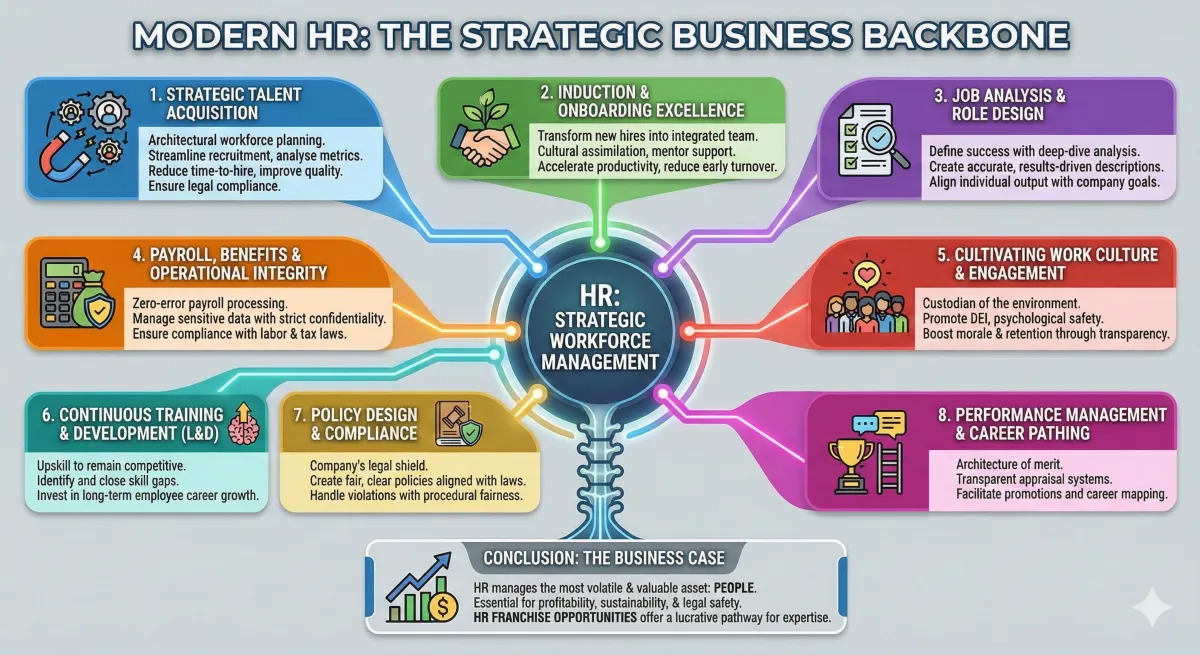
Here is an expert breakdown of the critical functions that define modern HR.
1. Strategic Talent Acquisition (Recruitment)
Recruitment is the gateway to your company’s future. It is not merely about filling a vacancy; it is about architectural workforce planning.
-
The Strategy: HR develops robust sourcing channels and manages Applicant Tracking Systems (ATS) to build a pipeline of qualified talent.
-
The Impact: By streamlining recruitment and analyzing hiring metrics, HR reduces “time-to-hire” costs and drastically improves the quality of new hires.
-
Compliance: Crucially, HR navigates the complex legal landscape of hiring, ensuring equal opportunity and protecting the company from liability during the selection process.
2. Induction & Onboarding Excellence
The first 90 days determine an employee’s longevity at a company. HR leads the induction process to transform a “new hire” into a fully integrated team member.
-
Beyond Paperwork: While administrative tasks are handled efficiently, the focus is on cultural assimilation.
-
Support Systems: Assigning mentors or “buddies” provides immediate support networks.
-
The Outcome: A structured onboarding program clarifies goals and expectations immediately, significantly reducing early turnover and accelerating the time it takes for an employee to become productive.
3. Job Analysis & Role Design
You cannot measure performance if you haven’t defined success. HR conducts deep-dive job analyses to identify exactly what competencies drive specific roles.
-
The Process: Examining key responsibilities to create accurate, results-driven job descriptions.
-
The Benefit: Clear job profiles align individual output with company objectives. When employees know exactly what is expected of them, engagement and job satisfaction rise naturally.
4. Payroll, Benefits & Operational Integrity
In the eyes of the employee, payroll accuracy is the foundation of trust.
-
Accuracy is Paramount: HR ensures the timely and precise processing of salaries, benefits, and taxes. This is a zero-error function.
-
Risk Management: Beyond calculations, HR manages sensitive data, ensuring strict confidentiality and compliance with evolving labor laws, tax regulations, and garnishment requirements.
5. Cultivating Work Culture & Engagement
Culture is what happens when leadership leaves the room. HR is the custodian of this environment.
-
Inclusion & Equity: promoting Diversity, Equity, and Inclusion (DEI) initiatives to ensure every employee feels valued.
-
Feedback Loops: HR fosters psychological safety through open communication channels and transparency.
-
Retention: By celebrating milestones and aligning daily work with company values, HR boosts morale and retention, saving the company the high cost of replacement hiring.
6. Continuous Training & Development (L&D)
A stagnant workforce leads to a stagnant business. HR ensures the organization remains competitive by upskilling its people.
-
Closing the Gap: identifying skill gaps within teams and designing custom training solutions to fill them.
-
Future-Proofing: Providing ongoing development opportunities not only improves performance but also signals to employees that the company is invested in their long-term career growth.
7. Policy Design & Compliance
In a changing legal environment, HR is the company’s shield.
-
Design & Update: Creating clear, fair policies that align with organizational goals and current legislation.
-
Enforcement: HR communicates these policies effectively and handles violations with procedural fairness, minimizing legal risks for the organization.
8. Performance Management & Career Pathing
High performers need to be recognized, and underperformers need guidance. HR manages the architecture of merit.
-
The System: Implementing transparent appraisal systems that rely on data and regular feedback, not just “gut feeling.”
-
Growth: facilitating promotions and career mapping. When employees see a future within the organization, they strive for excellence.
Conclusion: The Business Case for HR
Human Resources is multifaceted and indispensable. From the legal nuances of compliance to the psychological aspects of motivation, HR manages an organization’s most volatile and valuable asset: its people.
For entrepreneurs and business investors, the demand for professional HR management is at an all-time high. HR franchise opportunities offer a lucrative pathway to enter this essential industry, providing the expertise that growing businesses desperately need.