

Culture is not a poster on the wall or a ping-pong table in the breakroom. It is the operating system of your organization. It dictates how decisions are made, how conflict is resolved, and ultimately, whether your strategy succeeds or fails.
In a business landscape defined by rapid technological shifts and changing societal norms, a static culture is a liability. As HR leaders, we know that steering a ship through calm waters is easy; keeping the culture intact during a storm is where the real work happens. Wharton’s Nano Tools for Leaders puts it bluntly: cultural agility is no longer optional—it is a competitive necessity. But how do we move from the abstract concept of “culture change” to tangible execution?
Harvard Business Review suggests a mindset shift: stop treating culture change as a mandate and start treating it as a movement. Real change isn’t forced down from the C-Suite; it ripples out effectively when it is organic and lived by the people.
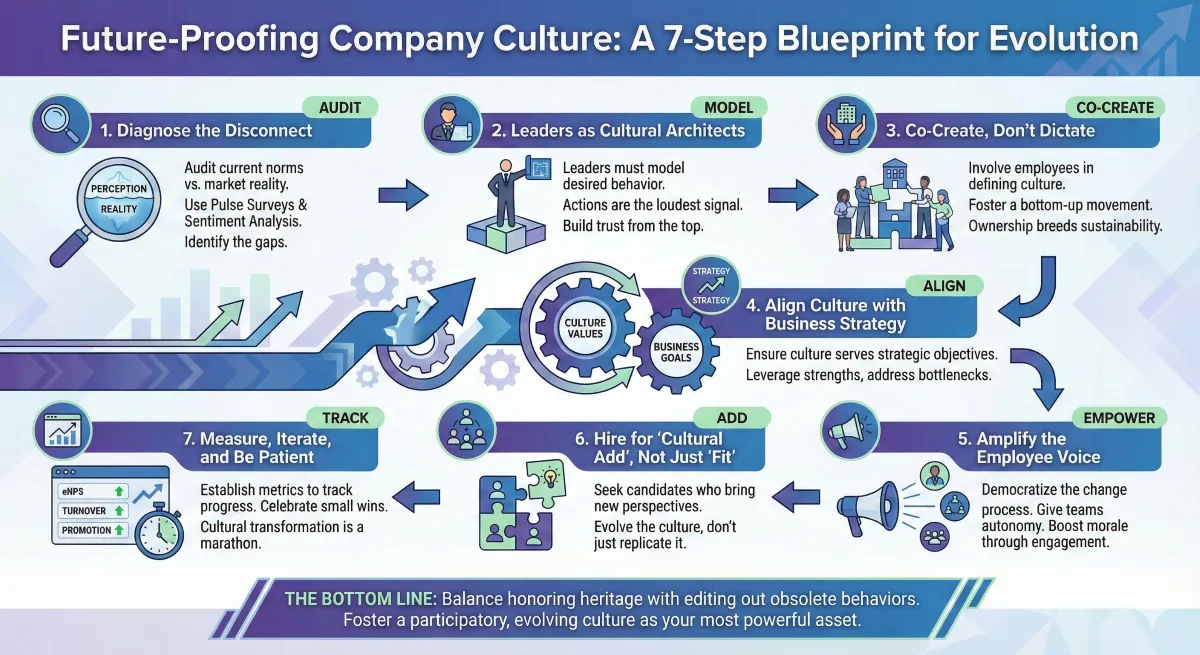
Drawing on decades of organizational development and insights from industry leaders like Harver, here is the 7-step blueprint for navigating cultural evolution.
1. Diagnose the Disconnect (The Zeitgeist Check)
You cannot fix what you do not understand. Before announcing a “new culture,” you must audit the old one. Use pulse surveys, anonymous focus groups, and sentiment analysis to understand the gap between who you say you are and who your employees think you are. Identify where your current norms clash with modern market expectations.
2. Leaders Must Be “Cultural Architects”
Employees don’t listen to what leaders say; they watch what leaders do. If the goal is a culture of transparency, but the Executive Team hoards information, the initiative fails immediately. Leaders must act as cultural custodians. Their behavior is the loudest signal in the room.
3. Co-Create, Don’t Dictate
Top-down cultural overhauls rarely stick. To create a movement, you need participation. Involve employees in defining what the “new” culture looks like. When people help build the house, they don’t burn it down. Ownership breeds sustainability.
4. Align Culture with Business Strategy
Culture cannot exist in a vacuum. It must serve the business goals. As Harver notes, we must set clear, measurable objectives. If your business strategy requires rapid innovation, but your culture punishes failure, you have a strategic misalignment. Your cultural plan must leverage existing strengths while aggressively addressing the bottlenecks.
5. Amplify the Employee Voice
Engagement is the fuel of transformation. Democratize the change process. Give teams the autonomy to interpret how the new cultural values apply to their specific daily tasks. When employees feel empowered to enact change, morale creates a flywheel effect.
6. Hire for “Cultural Add,” Not Just “Cultural Fit”
For years, HR focused on “Cultural Fit.” Today, that is a recipe for stagnation. We need to hire for Cultural Add. Look for candidates who share your core values but bring a new perspective or disposition that the team currently lacks. This ensures the culture evolves rather than becoming an echo chamber.
7. Measure, Iterate, and Be Patient
Cultural transformation is a marathon, not a sprint. It is not an overnight phenomenon. Establish metrics—turnover rates, eNPS, internal promotion rates—to track progress. Celebrate the small wins to keep momentum high, and have the patience to stay the course when the inevitable resistance arises.
The Proof: The Unilever Brasil Case
Look no further than Unilever Brasil for a roadmap. By focusing on deep personal reflection, honest dialogue, and value assessments, they didn’t just “feel better”—they saw tangible improvements in revenue growth and employee satisfaction.
The Bottom Line
Keeping your culture in sync with the times is a delicate balancing act. It requires honoring your heritage while ruthlessly editing out behaviors that no longer serve you. By fostering a participatory environment and following a structured approach, HR can ensure culture remains the organization’s most powerful asset.